




Mechanical and Physical Investigation (MPI) laboratory is an NABL accredited testing laboratory in accordance with the ISO/IEC 17025:2017 procedures in the field of mechanical investigation (Test Certificate No.-5296) of construction materials. The Lab has structured quality management system (QMS) and conducts frequent internal and external assessments to ensure consistent reliable laboratory results. Further MPI Lab also involve in homogeneity testing of Standard Reference Material (SRM) such as Bharatiya Nirdeshak Dravyas (BND’s) for various cementitious materials.
This lab has wide range of specialized testing facilities for conducting R&D studies. Laboratory has various state of the art facilities for the study of hardened concrete for various mechanical, durability and time-dependent properties.
State of the art facilities
- Chloride Ion Penetrability Testing Equipment
- Corrosion Rate Analyzer
- Strain Controlled Universal Testing Machine – 1000kN
- Strain Controlled Compression Testing Machine – 3000kN along with Flexural Testing Machine – 300kN
- Crack Monitoring of Reinforced Concrete Beams
- Determination of Toughness and Energy Absorption of Steel Fibre Reinforced Concrete and Shotcrete Panels
- Determination of Modulus of Elasticity and Poisson Ratio of Concrete
- Mercury Intrusion Porosimetry Equipment
- BET Apparatus for Surface Area Determination
- Tri-axial Shear Strength of Concrete – 500kN
- Temperature studies in concrete through thermocouples and Resistance Temperature Device and their recording in Data Loggers having multiple channels
- Water Permeability Testing Equipment
- Study on Carbonation-induced Concrete by keeping concrete samples in carbonation chambers
- Study on Long-term Sustained Loading on Concrete Samples in Creep Testing Machine
- Study on Corrosion Studies using Electrochemical Impedance Spectroscopy (EIS) Equipment
New Facilities Created during the Financial Year
- Rheometer for concrete and mortar to study the rheological properties of concrete
- Setup for Volumetric Expansion of Slag samples
- Rapid Chloride Penetrability Testing System with provision of chloride migration coefficient test
MPI activities
- Mechanical Testing of Building Materials such as Hydraulic Cement, Aggregates, Fly Ash, Bricks, Steel Bar, Ceramic Tiles, Vitrified Tiles, Cement Concrete Flooring Tiles, Autoclaved Aerated Blocks, Corrosion Inhibitor, Fresh Concrete, Epoxy, Latex & Hardened Concrete
- Determination of Alkali Aggregate Reactivity: Alkali Silica Reactivity & Alkali Carbonate Reactivity
- Admixture Testing
- Concrete Mix Design
- Soil Testing includes Grading, Optimum Moisture Content, CBR Test, Liquid Limit & Plastic Limit Test
- Fineness of cementitious and pozzolanic materials such as Microfine OPC, Ultrafine GGBFS, Silica Fume, etc. by BET apparatus
- Steel Fiber Testing
1. Mechanical Tests
- Modulus of elasticity and Poisson’s ratio
- Toughness and energy absorption on steel fibre reinforced concrete
- Stress-strain characteristics
- Fracture behaviour of beam
- Drying shrinkage of concrete
- Dry and wet abrasion of concrete
- Confined compression of concrete and rock
- Creep and fatigue test on concrete
- Checking the behaviour of reinforced concrete by testing of beams and columns
2. Durability tests based upon transport mechanisms and other tests
- Migration/Conduction: RCPT, NT Build 492, Florida Method
- Diffusion: Chloride diffusion/ponding, accelerated carbonation (laboratory as well as field study)
- Penetration: Permeability, volume of permeable voids
- Microstructure: Mercury intrusion porosimetry
- Chloride-induced corrosion: Polarizing resistance as per ASTM G3, LPR, EIS and Initial Surface Absorption Test
- Ingress of sulphate: Sulphate immersion test, mass loss test
- Various other corrosion-related tests such as long-term chloride-induced corrosion test for admixture as per ASTM G109/ASTM C1582
3. Analytical Equipment’s for microstructural studies
- Particle Size Diffraction Analyzer (0.04 µm–2500 µm)
- Mercury Intrusion Porosimeter (0.004 µm–10 µm)
- BET Apparatus
Apart from the testing of construction materials, laboratory has also provided demonstration and training to various groups from esteemed organization such as Public Works department (PWD), Gujarat Engineering Research Institute (GERI), Department of Irrigation, NHPC, Ultratech, NTPC etc., and recognized cement industry and also to many recognized academic institutions under various training programs.
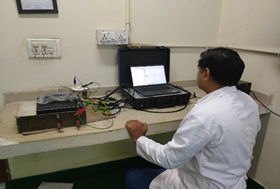
Corrossion Rate testing of concrete
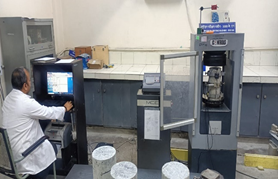
Modulus of Elasticity and Poisson’s Ratio Test on Concrete
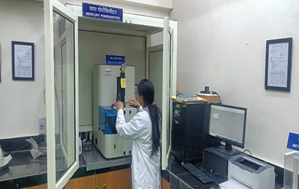
Mercury Intrusion Porosimetry Test
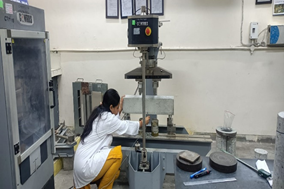
Measuring the Toughness of Fibre Reinforced Concrete Samples through Crack Mouth Opening Displacement Gauge
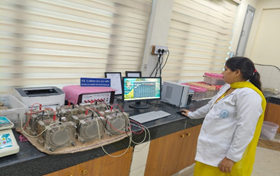
Rapid Chloride Penetrability test
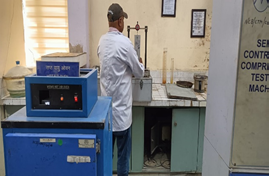
Drying shrinkage Test on Concrete
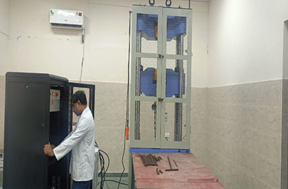
Steel Testing in Servo Controlled Universal Testing Machine.
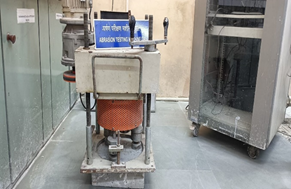
Abrasion of Concrete Sample.
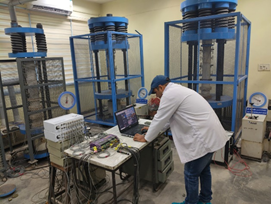
Hardened Concrete Sample- Creep Testing
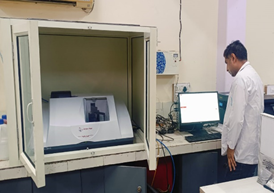
Particles Size Distribution (PSD)
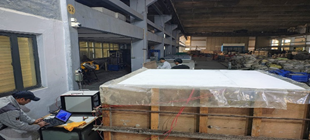
Temperature studies under progress on Concrete Samples using Thermocouples.