




The Structural Assessment and Rehabilitation (SAR) Programme at the National Council for Cement and Building Materials (NCB) continues to serve as one of the most technically comprehensive and field-tested infrastructure support services in the country. Over the years, the programme has evolved from a conventional inspection-and-testing service into a multi-disciplinary technical consulting platform - one that integrates field investigation, advanced laboratory science and evidence-based rehabilitation engineering.
A sustained pipeline of projects — spanning condition assessments, non-destructive evaluations and quality assurance works has reinforced NCB's standing as a trusted national authority on structural diagnostics and repair. The programme's reach extends across critical infrastructure sectors including power sector (NTPC, NHPC, CWC, PGCIL, BHEL, IPGCL and state-owned thermal power stations), public utilities and institutional facilities (CPWD, AIIMS, RBI, HSCC, RITES, MES, DDA, HSVP, Delhi University, IOCL, ITPO, c etc.).
SAR Programme addresses a fundamental challenge of built structure. Ageing structures often carry hidden deficiencies that, if left undiagnosed, can progressively compromise structural integrity and public safety. Through systematic investigation, scientific testing and expert guidance, the Programme enables asset owners and estate managers to make informed decisions about the repair and rehabilitation, of their structures - before distress escalates into failure.
Domain of SAR
The principal domains of activity under the SAR Programme encompass the following:
- Condition assessment of reinforced and plain concrete structures across various types of civil infrastructure
- Non-Destructive Testing (NDT) of new and existing concrete structures for quality conformance and monitoring
- Investigation of material properties of concrete in large hydraulic structures, including dams and associated water-retaining works
- Assessment of structures damaged by fire, covering extent of damage and repair & restoration methodology
- Recommending the repair methodology covering detailed technical specifications
- Load testing of RCC structures such as bridges and buildings
- Third-party quality assurance and technical supervision of repair works
Condition Assessment & Non-Destructive Testing
The durability and safety of concrete structures cannot be taken for granted - they need to be checked regularly to ensure they remain safe and durable. Bridges carry heavier loads than their original design anticipated. Buildings age under the twin effect of environmental exposure and deferred maintenance. Dams hold back enormous volumes of water under conditions that silently stress their internal matrix over decades. For all such structures, periodic condition assessment is essential for extended service life.
The SAR Programme's condition assessment services deliver to check up the structures and ensure timely maintenance so that the structures remain serviceable. The condition assessment projects are executed on a diverse range of structures, with investigations carried out in a structured three-phase methodology:
Phase 1 — Preliminary Site Investigation
Every condition assessment commences with a thorough preliminary site inspection. This phase involves a comprehensive visual survey of the structure, documentation of visible distress manifestations — including cracking patterns, concrete spalling, condition of embedded steel bars, surface staining, seepage & deformation along with photographic records. Equally important is the review of available construction history, design drawings, maintenance logs and any prior inspection reports. This background review helps to establish the structural context and guides in formulation of a detailed diagnostic testing scheme for condition assessment.
Phase 2: Non-Destructive Evaluation
Following the preliminary inspection, Non-Destructive-Testing (NDT) is performed to quantify the extent and severity of distress observed visually and to uncover sub-surface defects not apparently visible to the naked eye. The SAR Programme's NDT Laboratory holds NABL accreditation for limited testing.
The principal NDT techniques include the following:
- Ultrasonic Pulse Velocity (UPV) Testing — for assessment of concrete homogeneity, internal crack detection and relative quality mapping across structural elements
- Rebound Hammer Testing — for estimation of surface hardness and indicative in-situ compressive strength; particularly useful for comparative assessment across large structural areas
- Half-Cell Potential (HCP) Measurement — for probabilistic assessment of active corrosion in embedded reinforcement bars, a critical diagnostic tool for coastal, humid and chloride-exposed structures
- Electrical Resistivity Testing using Four-Point Wenner Probe — for quantification of concrete's resistance to ionic transport, a primary indicator of durability and corrosion risk
- Cover Meter / Electromagnetic Rebar Detector — for mapping the location, depth and spacing of reinforcement bars and verification of cover adequacy
- Air Permeability Testing using Torrent Permeability Tester — for quantitative assessment of the quality and durability of cover concrete, which is the primary defence against aggressive environmental ingress
- Pull-Off / Bond Strength Testing — for evaluation of interfacial adhesion of repair mortars, protective coatings and overlays applied to parent concrete substrates
- Portable Crack Width Measurement Microscope — for precise on-site measurement of surface crack widths, enabling classification of cracks as structural or non-structural
- Dry Film Thickness (DFT) Meter — for measurement of coating or protective layer thickness on structural surfaces
- UAV-Aided Infrared Thermography — an increasingly valuable technique for inspection of tall structures and large surface areas inaccessible by conventional means; thermal imaging detects sub-surface delamination, voids and moisture zones without scaffolding
Phase 3: Laboratory Testing
In-situ field investigations are complemented by laboratory testing of concrete cores and material samples extracted from the structure during the inspection. Core extraction is performed using high-quality diamond-tipped concrete coring equipment of various diameters, followed by precision-cutting and end-preparation to meet international testing standards.
Laboratory testing covers comprehensive evaluation of the following:
- Compressive strength determination on extracted cores
- Chloride content profiling across concrete depth — for assessment of chloride-induced corrosion risk
- Sulphate and pH measurement in hardened concrete — for detection of acid attack, carbonation, or chemical deterioration
- Carbonation depth assessment — for estimation of carbonation front towards embedded reinforcement bars
- Mercury Intrusion Porosimetry (MIP) — for detailed characterisation of the pore structure and permeability of concrete
- Differential Thermal Analysis and Thermo-Gravimetric Analysis (DTA/TGA) — for identification of mineralogical changes, particularly in fire-affected concrete
- X-Ray Diffraction (XRD) Analysis — for phase identification, detection of deleterious reactions and mineralogical characterisation
- Scanning Electron Microscopy (SEM) with Energy Dispersive Spectroscopy (EDS) — for high-resolution microstructural imaging and elemental mapping of concrete
The integration of field NDT findings with laboratory data provides a holistic and scientific assessment of structural condition, forming the foundation for evidence-based rehabilitation recommendations.
Services offered:
- Health and condition assessment of concrete and masonry structures including fire damaged structures.
- Detailed investigations of structures like buildings, bridges, dams, power plant RCC structures, chimneys, silos, overhead tanks, etc., to figure out the root cause of distress and formulate effective strategies for repair & rehabilitation along with use of novel technologies like cathodic protection systems.
- Non-destructive evaluation techniques like Rebound Hammer Test, Ultrasonic Pulse Velocity Test, concrete core extraction, half-cell potential measurement, rebar detection & concrete cover depth measurement, carbonation depth measurement, Electrical Resistivity Test, air permeability test, crack width and crack depth measurement, etc.
- Use of supplementary tests for investigations such as chemical analysis (for evaluation of pH, chlorides, sulphates, etc.) of hardened concrete samples collected from the site and other specialized tests such as Mercury Intrusion Porosimetry (MIP), Optical Microscopy (OM), Differential Thermal & Thermo-Gravimetric Analysis (TG-DTA), X-Ray Diffraction (XRD) Analysis, etc., which are made use of in analysis from time to time.
- Quality Inspection and Quality Assurance of ongoing repair & rehabilitation works.
- In-situ quality assessment and durability investigation of existing structures.
Some photographs of structures assessed under SAR projects undertaken by NCB
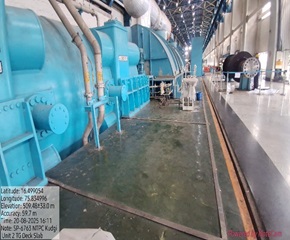
TG Deck Slab at NTPC Kudgi, Karnatka
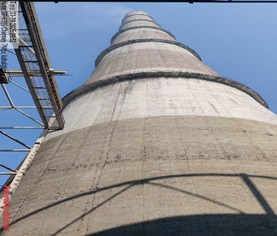
Chimney Shell at the NTPC Kahalgaon, Bihar
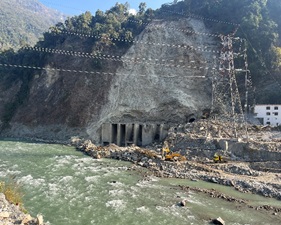
Teesta-V TRT (Tail Race Tunnel)
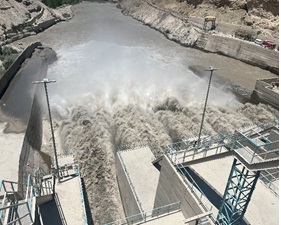
Nimoo Bazgo Power Station, Leh
Studies Undertaken:
Under the SAR programme NCB has carried out a large number of sponsored project works involving structural health and condition assessment of concrete structures, non-destructive testing of concrete structures, quality assurance services of ongoing repair work and has also undertaken a number of R&D studies pertaining to emerging repair and rehabilitation techmologies. Our clientele includes reputed Organizations like NTPC, PGCIL, NHPC, NHAI, RBI, BHEL, GAIL, AIIMS Delhi, CPWD, DDA (New Delhi), IPGCL, CSPGCL & APCPL. Some of the major studies executed under the SAR programme are:
- R&D studies on cathodic protection for reinforced concrete structures and concrete surface coatings.
- Condition assessment of Civil Structures at Ratnagiri Gas & Power Pvt. Ltd., Maharashtra.
- Carrying out Non-Destructive Testing for Investigation of Concrete of Srisailam Dam for Alkali Aggregate Reactivity and Study of the material emerging from the face of the gallery, Telangana.
- Condition Assessment of two Natural Draught Cooling Tower (NDCT) at 2x 500 MW, Atal Bihari Vajpayee Thermal Power Station (ABVTPS), CSPGCL, Janjgir, Champa.
- Condition Assessment of Cooling Tower - 1 at PPS-III, Pragati Power Co. Ltd., Bawana.
- Condition Assessment of Connecting Corridor of Front & Rear Blocks of NTPC’s R&D Building of Engineering Office Complex (EOC), Noida.
- Carrying out Non-Destructive Tests on Dam structure located at Dikchu site of Teesta-V Power Station situated on Teesta River in Gangtok District, Sikkim.
- Carrying out Non-Destructive Tests on Dam structure located at Kalijhora of Teesta-IV Power Station situated on Teesta River in Kalijhora, District Darjeeling, West Bengal - 734320.
- Carrying out Non-Destructive Tests on Dam structure located at Rambhi site of Teesta Low Dam (TLD)-III Power Station situated on Teesta River in Darjeeling District, West Bengal.
- Condition Assessment of various RCC structures (20 Nos.) in plant area at Farakka Super Thermal Power Station, NTPC Ltd., West Bengal.
- Condition Assessment of various RCC structures (17 Nos.) of Stage-II & Stage-III in plant area at Farakka Super Thermal Power Station, NTPC Ltd., West Bengal.
- Condition Assessment of residential quarters in AV Nagar Campus of AIIMS, New Delhi.
- Condition Assessment of Residential Quarters of Type-B (14 nos.), Type-C (4 nos.), & Transit Camp at PGCIL 400/220 kV Mandola Substation, Loni Bagpat Road, Ghaziabad, Uttar Pradesh.
- Condition Assessment of Building of District Centre at Janakpuri, DDA, New Delhi.
- Carrying out testing of TG Decks of Unit #1 & Unit #2 at NTPC Darlipali, Odisha.
Some of photographs of the project sites and site assessment work done by NCB team in various projects:
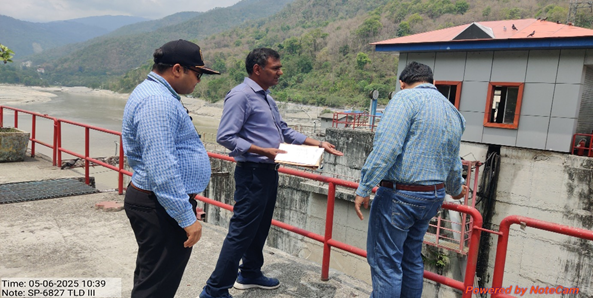
During Preliminary Site Inspection Meeting with client at Teesta-III Dam site
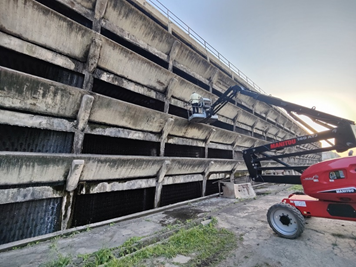
During Preliminary Site Inspection Meeting with client at Subansiri Dam site
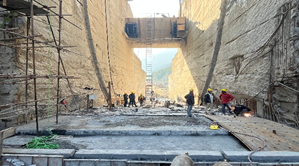
Project site of NDT testing of Teesta-V Dam Structure, Sikkim
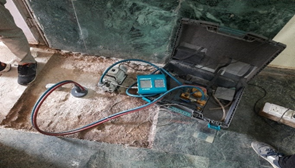
Concrete Air Permeability Test being done at site
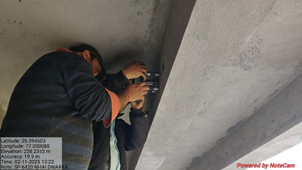
Bond strength of repair material testing at site of NHAI Residential Enclave at Dwarka, New Delhi
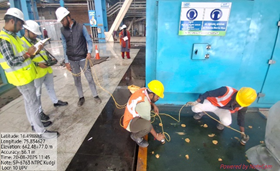
UPV Test on TG Deck Slab at NTPC Kudgi
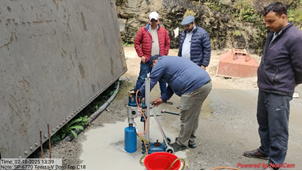
Concrete Core Extraction from the Dam Top of Teesta-V, Sikkim
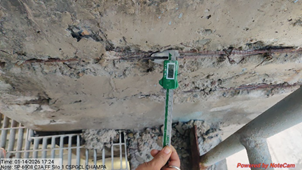
Measurement of rebar diameter of an RCC member
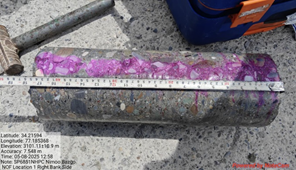
Carbonation depth measured on freshly extracted concrete core at site
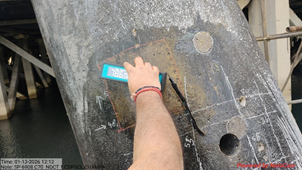
Electrical Resistivity Measurement at site
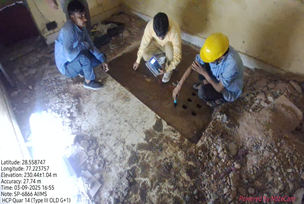
Half Cell Potential testing at site
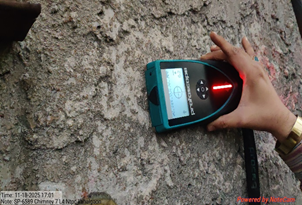
Concrete testing at site
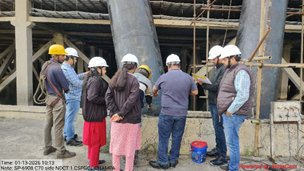
Concrete cover measurement at site
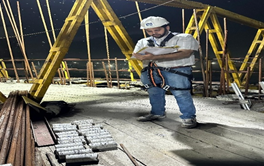
Extracted Concrete core samples from Chimney at Kahalgaon, Bihar
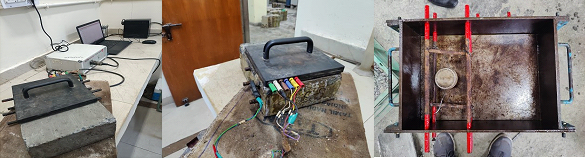
Corrosion rate measurement on RCC specimens using LPR technique for evaluation of effectiveness of sacrificial anodes
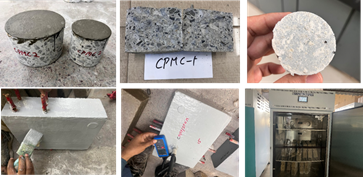
Laboratory investigations on surface coated concrete specimens to study the effectiveness of concrete surface coatings